Top Post Views

3: Malaysia REITs - Looking For My 2nd Durian Runtuh
4: Is Insurance Really Necessary?
5: Everyone Must be A Millionaire

Head to the watch list on the above tab to see my what's on my radar and foreseeable future postings =)

Decided to make adjustments on the way I blog & share due to time constraints and other commitments. In the coming weeks you should see them. Short updates but more frequent & concise.

Tuesday, July 7, 2015

Aboi's Portfolio Review For July 2015

Bugis Bucaneer. As of July 7th: 1 US Dollar equals 3.83 Malaysian Ringgit 

Highlights
- Portfolio's increased in value even when global markets are volatile (Greece's default and possible exit from Eurozone) and in the wake of more Malaysian financial worries (1MDB, "lanun" Bugis, MYR continued weakness) 
- Maintain all ratings, similar as June'2015. Aboi's Portfolio Review For June 2015.
- No new additions in June. Likely to have one in July :)
- Beginning next month I will also talk about my US holdings (sold all back in May 2015 except for Costco) and figure out how to integrate it within here.

Portfolio target composition. Equities 65%, Bonds 25% and Supplementary 10%.
Targets for returns p.a. Equities 12%, Bonds 5% and Supplementary 3.5%.

Notes
- Nil

Comments
- Portfolio target for the 5th year @ RM156k for April 2015: Slightly OFF. 
- Portfolio target for the 6th year @ RM171k for April 2016.
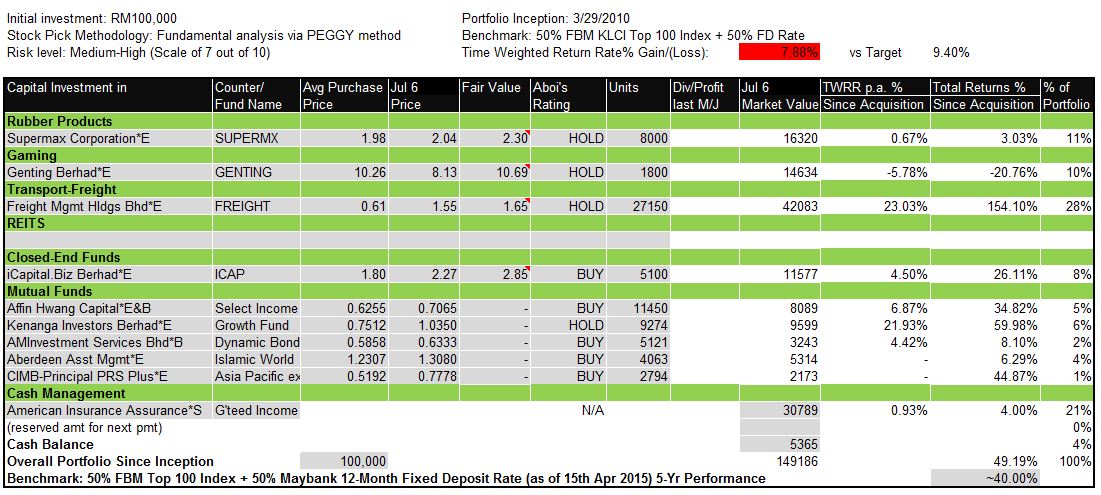
- The TWRR (time weighted annual return rate = 7.88% 
- TWRR up by 0.18% from June'15 vs portfolio target = 9.40%).

Supermax (Equity Malaysia)
- Maintain HOLD. Uncertainty in local stock market.
- Maintain fair value (RM2.30). No new developments. See below for previous month June'2015 update.
- Stock crippled due to fire at its Alor Gajah plant but has since recovered.
- Growth in capacity from two new plants in Meru, Klang which will double nitrile gloves production from 6.9b to 12.3b pieces p.a.
- Still has attractive valuations vs peers e.g. PER & Div Yield.

Genting (Equity Malaysia)
- Maintain HOLD. Uncertainty in local stock market.
- Maintain fair value (RM10.69). No new developments. Stock took more beating and is further undervalued, no reason to sell as fundamentals have not changed. See below for previous month June'2015 update.
- However most of its current investments will only come to fruition in 2H15/2016 so there is no short term catalyst to prop up share price.

Freight (Equity Malaysia)
- Maintain HOLD. Uncertainty in local stock market.
- Maintain fair value (RM1.65). No new developments. See below for previous month June'2015 update.
- Stock took a beating due to cessation of a 3PL contract and temporary closure of a warehouse for renovation but expected to slowly recover.
- Growth will be supported by its core Sea Freight division and trade within Asia-Australia region.

ICapital (Closed-End Fund Equity Malaysia)
- Maintain BUY.
- Huge discount from current price to NAV (20.35%)

Affin Hwang Select Income Fund (Equity & Bond - Asia)
- Maintain BUY.
- Asia Pacific's healthy credit market more or less can offset stronger USD in the coming months. See below for previous month June'2015 update.

-Strong USD will make headwinds for Asia markets as such fund pare down exposure in equities (30% -> 20%). 
- Also doubled cash levels to 7% and continue exposure on Asian credit market pending US Fed's direction in the 2H15.   

Kenanga Growth Fund (Equity Malaysia)
- Maintain HOLD. Uncertainty in local stock market.
- Because fund held so much cash, impact from recent KLCI activity is very minimal. See below for previous month June'2015 update.


- Lack of catalyst in the short term, fund holding high level of cash ~20-25%.
FUND PERFORMANCE (BID TO BID CUMULATIVE RETURNS)
Period1 wk1 mth3 mth6 mthYTD1 yr2 yr3 yr5 yr10 yr
Bid to Bid Returns (%) - RM0.5-0.41.514.014.137.938.069.3157.9401.5
Performance figures are absolute returns based on the price of the fund as at July 3, 2015 (Last updated on July 6, 2015),on NAV-to-NAV basis,with dividends being 'reinvested' on the dividend date.

AmDynamic Bond Fund (Bond Malaysia)
- Maintain BUY.
- No change in my commentary but have to be aware of BNM 4th MPC meeting in 2 days. See below for previous month June'2015 update.

- Mainly invested in local corporate bonds ~80%. Interest rate expected to remain still.
- BNM will likely continue its policy pause and maintain cautious stance with a "wait-and-see" approach on US Fed direction.
FUND PERFORMANCE (BID TO BID CUMULATIVE RETURNS)
Period1 wk1 mth3 mth6 mthYTD1 yr2 yr3 yr5 yr10 yr
Bid to Bid Returns (%) - RM0.20.71.53.53.387.76.313.336.1119.1
Performance figures are absolute returns based on the price of the fund as at July 2, 2015 (Last updated on July 6, 2015),on NAV-to-NAV basis,with dividends being 'reinvested' on the dividend date.

Aberdeen Islamic World Equity Fund (Equity Global)
- Maintain BUY.
- Thanks to Greece, fund retreated slightly due to its medium exposure in Europe. However I see opportunity in current selloff, Greece not likely to have a big impact in Europe's financial woes as it once did in 2012. See below for previous month June'2015 update.

- Fund has no exposure to China's overheated stock market and slowing economy. Fund also has 18% exposure to the already lofty valuations in US equities so impact is minimized if a correction occurs.
- Fund continues to be very diversified globally; Healthcare (21%), Materials (16%), Energy (15%), Industrial (13%), Consumer Staples (13%).
FUND PERFORMANCE (BID TO BID CUMULATIVE RETURNS)
Period1 wk1 mth3 mth6 mthYTD1 yr2 yr3 yr5 yr10 yr
Bid to Bid Returns (%) - RM-1.7-1.40.56.86.46.332.3---
Performance figures are absolute returns based on the price of the fund as at July 2, 2015 (Last updated on July 6, 2015),on NAV-to-NAV basis,with dividends being 'reinvested' on the dividend date

CIMB Principal PRS Asia Pacific Ex Japan Equity Fund (Equity Asia)
- Maintain BUY.
- Shanghai's stock market corrected by as much as 16% to date but fund's exposure is minimal so I'm safe. Fund's recent weakness is mainly attributed to Greece event causing some selloff in almost all major markets worldwide including Asia Pacific. See below for previous month June'2015 update.

- Fund holding exposure to China's overheated stock market is minimal ~10%.
- Positive on Asian Equities but growth will be more scarce moving forward as regional portfolios are fully invested hence earnings will depend highly on stock selection.
FUND PERFORMANCE (BID TO BID CUMULATIVE RETURNS)
Period1 wk1 mth3 mth6 mthYTD1 yr2 yr3 yr5 yr10 yr
Bid to Bid Returns (%) - RM-1.10.41.210.210.7820.143.4---
Performance figures are absolute returns based on the price of the fund as at July 2, 2015 (Last updated on July 6, 2015),on NAV-to-NAV basis,with dividends being 'reinvested' on the dividend date


Disclaimer: The reports, analysis and recommendations in this blog are solely my personal views. I do not link to any investment body or company. As such, I will not be responsible of any of your investment decision. Consult your investment adviser or come to your own conclusions before making any investment decision.

Thursday, July 2, 2015

Weekly Market Highlights July (1)

Source: Amp Capital (here for full market update) & iCapital biz (subscription required)

United States
US data was mostly good, but the growth rebound after the March quarter soft patch is still looking slower than that seen last year. Housing indicators remain solid, unemployment claims and weekly mortgage applications are continuing to improve, consumer spending was strong in May and consumer confidence rose in June. But against this, the Markit business conditions PMIs for June fell to still OK levels. The Fed is on track to hike later this year, probably in September, but the trajectory of rate hikes is likely to be very gradual. The main focus will be on June manufacturing and jobs data (expect to see a 1% gain existing home sales (Monday), further gains in home prices and consumer confidence (Tuesday), a slight gain in the ISM manufacturing conditions index (Wednesday)
to 53, another solid 225,000 gain in June payrolls and a fall in unemployment to 5.4% (both Friday). Overall healthy news coming from the world's biggest economy.

Eurozone
The Greek saga continues. After getting a lot closer on a deal but then failing to quite get there, Greek PM Tsipras has now called a referendum for July 5 on the latest offer from Greece's creditors. This will probably pass with polls indicating two thirds of Greeks want to stay in the Euro, and around 56% saying that this should be the case even if it involves a bad deal with Greece’s creditors. The week ahead will involve significant uncertainty. A missed payment to the IMF on June 30 was handled by the IMF allowing Greece to be in "arrears" until the outcome of the referendum is known. If Grexit is the way it goes, at some point it will provide a big relief rally for Eurozone shares, as it will mean the whole silly, nearly six-year long debacle with Greece is finally over. It’s worth reiterating the rest of Europe is in far better shape now to withstand a Grexit than was the case through the 2010-12 Eurozone crisis so the fall out in financial markets should be limited.

Asia
China cuts interest rates again, expect more easing ahead. Benchmark 12 month interest rate was cut by another 0.25%, taking it to 4.85%, and has cut the required reserve ratio for some banks by another 0.5%. Chinese share market fell 19% from its high two weeks ago so it provided a reason to cut interest rates. More fundamentally, monetary easing is justified. Producer price deflation of around 5% year-on-year has meant real borrowing rates for many businesses are way too high. Expect the 12 month lending rate to be cut to 4% or below by year-end. 
But China saw some good economic news with the flash Markit manufacturing PMI up a bit more than expected to 49.6 in June and consumer confidence up 1% in June. That said, it’s hard to get too excited as the PMI is still wallowing around in the same 48-52 range it’s been in for four years now.

Japan's manufacturing PMI for June was disappointing, but other Japanese data was more positive with the unemployment rate remaining at its lowest since 1997, the jobs to applicants ratio rising to its highest since 1992 and household spending up strongly from its tax hike, driven low a year ago. Core inflation remains too low though at 0.4% year-on-year, indicating pressure remains on the Bank of Japan for more easing.

Official home price data for the March quarter confirmed that growth is mainly being driven by Sydney. While home prices in Sydney rose 13% over the year to the March quarter, the average pace across the other capital cities is just 2.2%. All Australian cities suffer from poor affordability, but after a couple of years of double-digit gains the Sydney market is looking a bit bubbly with buyers seemingly getting attracted by the pace of gains. It clearly needs to slow. 

Over in Malaysia, we just avoided a Fitch (rating agency) downgrade though I reserve my doubts as articulated in these articles: 
Fitch Ratings – How They Make Money By Making Clients Happy
No rest for Malaysia as investors seek fixes beyond Fitch approval. 
Things on the ground don't look good at all. Increase in CPI (up 0.4% from a month ago and 2.1 from a year ago) is an effect of GST implementation.
   
Car sales are down. Year on year basis passenger and commercial vehicles sales are down 8.0% and 11.5% respectively. Spending is dampen due  to unfavourable exchange rates as well as GST implementation increasing living cost tremendously.

Also our house price index is on the downtrend. The number of residential property transactions in the prime areas such as Kuala Lumpur and Penang saw YoY declines of 7.1% and 10.7% respectively within the same period. On the supply side, the incoming supply of properties continued to trend higher, particularly within the service apartment and condominium category, which expanded by 5.1% quarter-on-quarter (QoQ), significantly faster than the industry growth rate of 2.6% QoQ. Construction projects for property in the initial stage also increased by 23.1% on a QoQ basis, marking its highest level of growth since 1Q14. With the continued expansion of property supplies, the oversupply condition is poised to get worse. More supply, less demand = further declines in house index and price. 2017?
FSM In The Malaysian Reserve: Dark Days Ahead For Property Market?

Tuesday, June 30, 2015

High Income Nation By 2020?

Based on the original post: High Income Nation By 2020? Dream On. You should spend time to read this as well. There are figures to back up the arguments.


What upset me is when I read this news today:
http://www.themalaysianinsider.com/malaysia/article/1.5-million-bangladeshi-workers-to-arrive-in-3-years-says-home-minister#sthash.vfpBY8J5.dpbs

Here's the snippets:
  • 1.5 million Bangladeshi workers to arrive in 3 years, says home minister
  • These workers will be involved in various fields, especially in the plantation sector and will meet the demands of the job market in Peninsular Malaysia, Sabah and Sarawak.
  • "However, this initiative only involves fresh workers from Bangladesh. Illegal Bangladeshi immigrants working here are not involved and we will continue to deport them," he said in Malacca today. (Belum kira illegals lagi beb)

Disease (One of it)
  • Low-skill jobs equal low wages
  • In Malaysia, not enough high-wage jobs have been created. In fact the share of skilled labour has declined across industries.
  • The E&E sector, which is the major contributor to Malaysia’s growth, has experienced some 
  • of the biggest declines in use of high-skilled labour.
  • ...employers do not pay for skills, relying instead on tried and tested means such as a readily available pool of unskilled foreign workers and underpriced resources to generate profits.
  • Immigration policies favour low skilled and cheap labour. Between 1990 and 2005, foreign labour contributed more than a third of the increase in total labour supply, and over 98% were low-skilled contract migrant workers.
  • Malaysian firms prefer to undertake less sophisticated activities, such as upgrading existing product lines or machinery and equipment. Activities that give rise to greater innovation and require the filing of patents are undertaken less frequently.
Broad decrease in the use of high-skilled workers in all industries


I have stressed this before back in 2012 in my blog post (Malaysia 2020 Is Not A Vision, It's A Dream) as a big problem plaguing Malaysia: We attract "mainly" low skilled workers; laborers.