Original Post back in Oct 2012. It's nearly 3 years.
http://aboiwealthpot.blogspot.com/2012/10/examining-aias-investment-linked-funds.html
I will reiterates some of my points again. Investment-linked policies offer:
1. Low insurance charges: As this is based on age, for young people entering the workforce you can obtain high coverage at low cost.
2. Many other benefits: Hospitalization, accidental, critical illnesses and many other protection benefits can be added on top of the standard ILP.
3. Visibility/transparency: ILP reveals how the premium allocation is made on your statement. You will also get an annual report on how your fund is performing.
4. Investment strategy in your hands: You can decide your risk level, choose which fund to invest, fund switching and portfolio allocation.
**Please note that ILP by insurance companies are not supposed to generate money for retirement. After all insurance plans are essentially protection providers NOT wealth generators (this is a great misconception by people). The returns are meant to offset the higher insurance charges (but you still pay the same premium) as you grow older thus as more returns are achieved, the longer the plan will last/the better coverage you can add later on in life. These four founds also share some similarities: they have been around for 10 years and small in size for their category (except for fixed income fund).
3 years ago I picked 4 funds and they have performed amazingly. The red arrow was when I first made my pick on them.
AIA Aggressive Fund (Local Equities)
CAGR of 11.55% beating benchmark by 2.60%.
AIA Medium Cap Fund (Local Equities)
CAGR of 11.72% beating benchmark by 2.29%.
AIA Dana Dinamik (Local Equities)
CAGR of 10.36% beating benchmark by 1.82%.
AIA Fixed Income Fund (Local Bond)
CAGR of 5.50% beating benchmark by 0.64%.
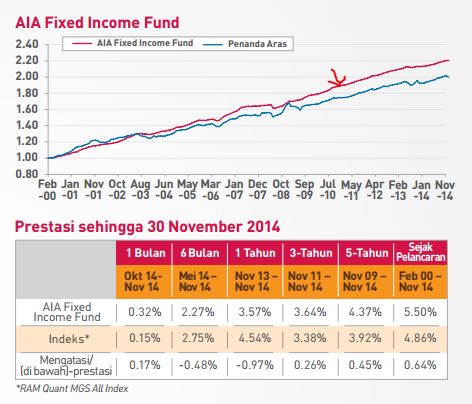
Of these four funds (all are domestic to Malaysia), 3 are 100% equities and only 1 falls under the fixed income securities category. Pure equity funds are volatile in nature and tend to correlate with stock market sentiment. All 3 have major exposure on trading/services sector, industrial products and finance. Malaysia's economy is highly dependent on growth in these areas and these sectors in total contribute a large amount of total GDP to the country. As such the easiest barometer to gauge the fund performance is to look at the KLCI. Fixed income securities however are generally stable with lesser returns.
The other funds performance continue to pale in comparison. The table below will describe them.
Summary:
1. Red ones are all funds with foreign exposure (be it direct stock selection or feeder fund). Continue to avoid them at all costs, AIA fund managers have a hard time even getting + returns when investing beyond our shores and they still do after 3 years.
2. Two new funds were launched in 2012, as it is still new I have to ignore them until I have at least 3 years' worth of data. My next update on ILP funds should begin to factor them in.
3. Back in Oct 2012: *AIA Equity Dividend Fund on prospectus looks promising. It invests only in Bursa's blue chip counters that provide strong dividend payouts.
-> Indeed it has performed well (CAGR of 10.89%), matching the performance level of the 3 funds I have selected. But it's still new, testing times like now should test the fund's resilience, we will see.
4. Back in Oct 2012: I personally picked AIA Aggressive Fund (trading/services), AIA Medium Cap Fund (industrial products & consumer) and the AIA Fixed Income Fund (finance borrowings). At 33% allocation each, I am seeing a 9.2% return p.a. based on historical data. To add some leeway, I have only a 8% expectation =)
-> In the 3 years period they have managed to return me 9.887% (Jul 2012 to Jul 2015)
[1] aggressive 25.33% total return (3 years) = 7.82% cagr * 0.33 = 2.581%
[2] dana dinamik 27.96% total return (3 years) = 8.57% cagr * 0.33 = 2.828%
[3] medium 46.50% total return (3 years) = 13.57% cagr * 0.33 = 4.478%
I do not think (nor hope or expect) to see such returns being replicated in the coming 3 years due to the current economic conditions. However these funds are holding high levels of cash (Medium Cap: 26%, Aggressive: 15%, Dana Dinamik: 16%) usually reserved to cherry pick good stocks during bad times like we are experiencing now so there is room for optimism in the long run. When the SUPER MORON leaves office [1] MYR will strengthen [2] KLCI will jump..just hang on folks.
Data Source: AIA Investment Linked Funds Performance 2014
Top Post Views
3: Malaysia REITs - Looking For My 2nd Durian Runtuh
4: Is Insurance Really Necessary?
5: Everyone Must be A Millionaire
4: Is Insurance Really Necessary?
5: Everyone Must be A Millionaire
Head to the watch list on the above tab to see my what's on my radar and foreseeable future postings =)
Decided to make adjustments on the way I blog & share due to time constraints and other commitments. In the coming weeks you should see them. Short updates but more frequent & concise.
Thursday, July 30, 2015
Sunday, July 26, 2015
Sunday Lite: Flip Flop In Malaysia's Property Market
Source material:
http://www.establishmentpost.com/malaysia-property-flipping-ugly-effect/#ixzz3gnWGEUdE
Malaysia Property Flipping and its Ugly Effect
The mighty flippers may flop
Getting the DIBS on Malaysia Property Flipping
My comments :
Everybody knows Malaysia has the highest household debt to GDP ratio in Asia. Below was taken in 2013, it is even higher now.
House prices are lagging indicators of the economy (& our economy is not doing good) simply because it is illiquid (you can't sell it as fast as selling off shares). I told a couple of folks that the year it's going to be is 2017 and I still stand by it.
At present economic conditions, BNM will not raise interest rates. It cannot and will not. [1] Lower interest rate is needed to spur economic borrowing and spending during bad times like now. [2] An increase in the rate will burden borrowers, make credit harder to obtain and certainly will mean bad news for property as it based highly on leverage.
This is why the Ringgit will continue to weaken and there is nothing much BNM can do about it except to smooth the decline by burning more reserves.
Elsewhere, property flipping is losing its appeal
http://www.establishmentpost.com/malaysia-property-flipping-ugly-effect/#ixzz3gnWGEUdE
Malaysia Property Flipping and its Ugly Effect
- It was the lure of fast and easy money, lots of it, that made James Lam jump at the chance to be a Malaysia property speculator or property flipping.
- “I was greedy.” says the 53-year-old who is in the top management of a multinational company. He already has a well-paying job, but the opportunity was too good to resist.
- One way of beating the system is to secure loans for several properties from as many banks all at the same time.
- Once Mr Lam gets the bank loans, he has to make sure he sells the properties quickly and at a higher price before the loan repayment commences. He has a small window period of a few months to get this done.
- But this did not happen for the two properties in a prime area in Kuala Lumpur that he now has. “I cannot get a buyer. Not even a tenant (to rent). I have to start paying the banks for the loans with my own money.”
- He also realises that the property market is slowing down and his chances of selling these properties off is getting slimmer by the day. With Real Property Gains Tax made steeper in 2014 at 30 per cent for properties sold within three years, he would need to have a huge profit margin to offset the tax.
My comments :
Indeed it has slowed down. Besides the house price index the number of property transactions has also fallen. If you don't believe in numbers just head to any property fair in town and you can count the # of visitors with your pair of hands.
The mighty flippers may flop
- Situations like this are nothing new to Siva Shanker. He has seen loads of such cases and he does not see a rosy end to this tale.
- His 34 years of experience as a real estate agent tells him that Mr Lam will either start cutting down his expenses so he has spare money to service the banks loans until a buyer comes along. “Or he will start borrowing from relatives or, worst still, from loan sharks.”
- “A sharp rise in value (of properties) creates the flipping culture,” he tells The Establishment Post. “In 2010, 2011 and 2012, thousands of properties were sold to flippers. These are people who neither need the property nor can afford to buy it. They buy it purely on speculation,” adds Mr Shanker, the immediate past president of the Malaysian Institute of Estate Agents.
Getting the DIBS on Malaysia Property Flipping
- One of the reasons for a huge rise in flippers is the Developer Interest-Bearing Scheme (Dibs) where a house buyer need not pay down payment upon signing of the sale and purchase agreement.
- The developer will also bear the other expenses like stamp duty, legal fees and also interest on finance during the project construction period until the handing over of the keys. In essence, the buyer only pays for 90 per cent of the property value. In Malaysia, down payment for properties is at 10 per cent.
- But speculators do not realise is that the value of properties sold under Dibs are actually marked up. This artificially hikes the property value and has caused the property market to rise unnaturally.
- Dibs was scrapped in Malaysia Budget 2014. Bank Negara was forced to take this measure when household debt soared to 86.8 percent of gross domestic product in 2013.
- But the worst is not over. The effect of Malaysia property flipping is going to hit the property market in a bad way, according to Mr Shanker. “We will see a new category in property transactions – properties from flippers.” Presently, all property transactions involve the primary market, which are the newly built units, and the secondary market, which are the houses built and bought long ago that have now been sold.
- He feels this category of property transactions will constitute a sizeable “5 to 10 per cent of new stock”. Flippers may be forced to sell their properties at much reduced, or even lower than the purchase price, so not to be saddled with a property they cannot afford to hold.
- So when a sizeable number of properties are made available in the market at much reduced prices, it is not going to be pretty for property investors and owners.
My comments :
Everybody knows Malaysia has the highest household debt to GDP ratio in Asia. Below was taken in 2013, it is even higher now.
House prices are lagging indicators of the economy (& our economy is not doing good) simply because it is illiquid (you can't sell it as fast as selling off shares). I told a couple of folks that the year it's going to be is 2017 and I still stand by it.
At present economic conditions, BNM will not raise interest rates. It cannot and will not. [1] Lower interest rate is needed to spur economic borrowing and spending during bad times like now. [2] An increase in the rate will burden borrowers, make credit harder to obtain and certainly will mean bad news for property as it based highly on leverage.
This is why the Ringgit will continue to weaken and there is nothing much BNM can do about it except to smooth the decline by burning more reserves.
Elsewhere, property flipping is losing its appeal
- Property flipping is fast becoming a thing of the past in the West. “China, Singapore, Malaysia, Hong Kong are now where the West have been and gone through,” Vijay Manavalan, a property negotiator in Malaysia involved in promoting properties in UK for investment.
- “To get value out of property investment, it is best to get slow income, and not flip. There will not be many more markets around the world to flip. Investors need to look at the rental income that can be generated,” he tells The Establishment Post.
- With a combination of government measures and diminishing opportunities, Malaysia property flipping may just be a thing of the past and Malaysian property market can be allowed to grow naturally and at a steady pace.
Labels:
Malaysian Economy,
Malaysian Property
Thursday, July 23, 2015
Weekly Market Highlights July (3)
Source: Amp Capital (here for full market update) & iCapital biz (subscription required)
Share markets have had a good week reflecting good news regarding Greece, better-than-expected Chinese economic data, the nuclear agreement with Iran and benign comments from US Federal Reserve chair Janet Yellen. The US dollar continued to drift higher with the perception that the US Federal Reserve is still on track to hike rates later this year (now that global risks have faded a bit) and this saw the Australian dollar, euro and yen fall. Commodity prices remained weak including oil on the back of the agreement with Iran.
More oil to hit an already oversupplied oil market. Agreement was also reached between Iran and the US to curb the former's nuclear program and remove sanctions. Assuming it is finalised, this is good news, in particular to the extent that it will see a boost to global oil supply ultimately of around 1% per annum, providing another dampener on the world oil price. Over the last year world oil production expanded 3.1 million barrels per day, but demand only rose by 1.4 million barrels per day.
United States
US economic data was a mixed bag. While data for housing starts and permits, industrial production and the New York regional manufacturing conditions survey improved more than expected, June retail sales disappointed, the Philadelphia regional manufacturing conditions survey fell, small business confidence fell and consumer confidence slipped (but probably due to all the noise around Greece and China). Inflation readings were also mixed with producer prices up a bit more than expected but import prices remaining weak, and consumer prices in line with expectations.
So while US Federal Reserve Chair Janet Yellen is still expecting to raise interest rates later this year, it’s dependent on a further improvement in growth coming through and while the September US Federal Reserve meeting is ‘live’ for a hike it looks only 50/50 at this stage.
US June quarter company earnings are doing it again. Each quarter market expectations for US profits get guided too low and the actual outcome ends up being better. The same seems to be happening for the June quarter results, where the consensus started with a -5.3% year on year decline, but after 72% of results to date have beaten expectations has already been revised up to -3.2%. It’s likely to end up slightly positive. So yes the strong US dollar is impacting but not as much as feared.
Chinese economic data was all a bit stronger than expected, confirming earlier signs that growth had improved somewhat. June quarter gross domestic product growth held constant at 7% year-on-year, but improved on a quarterly basis from 1.4% to 1.7%.
The Bank of Japan left monetary policy unchanged but nudged down its growth and inflation forecasts a bit. Further easing is still possible with inflation well below target.
Not much exiting news in Malaysia, mostly 1MDB's never ending saga. The most interesting item to look forward is our Budget in the month of October as well as Q2 economic numbers in the coming weeks. This was in Bloomberg's front page news this week after Dow Jones tells PM's lawyers to school client.
Share markets have had a good week reflecting good news regarding Greece, better-than-expected Chinese economic data, the nuclear agreement with Iran and benign comments from US Federal Reserve chair Janet Yellen. The US dollar continued to drift higher with the perception that the US Federal Reserve is still on track to hike rates later this year (now that global risks have faded a bit) and this saw the Australian dollar, euro and yen fall. Commodity prices remained weak including oil on the back of the agreement with Iran.
More oil to hit an already oversupplied oil market. Agreement was also reached between Iran and the US to curb the former's nuclear program and remove sanctions. Assuming it is finalised, this is good news, in particular to the extent that it will see a boost to global oil supply ultimately of around 1% per annum, providing another dampener on the world oil price. Over the last year world oil production expanded 3.1 million barrels per day, but demand only rose by 1.4 million barrels per day.
United States
US economic data was a mixed bag. While data for housing starts and permits, industrial production and the New York regional manufacturing conditions survey improved more than expected, June retail sales disappointed, the Philadelphia regional manufacturing conditions survey fell, small business confidence fell and consumer confidence slipped (but probably due to all the noise around Greece and China). Inflation readings were also mixed with producer prices up a bit more than expected but import prices remaining weak, and consumer prices in line with expectations.
So while US Federal Reserve Chair Janet Yellen is still expecting to raise interest rates later this year, it’s dependent on a further improvement in growth coming through and while the September US Federal Reserve meeting is ‘live’ for a hike it looks only 50/50 at this stage.
US June quarter company earnings are doing it again. Each quarter market expectations for US profits get guided too low and the actual outcome ends up being better. The same seems to be happening for the June quarter results, where the consensus started with a -5.3% year on year decline, but after 72% of results to date have beaten expectations has already been revised up to -3.2%. It’s likely to end up slightly positive. So yes the strong US dollar is impacting but not as much as feared.
Eurozone
Grexit off! - at least for now. Agreement was finally reached between Greece and its creditors on a path towards a new three-year bailout program. Greece has met its commitment to pass various reforms through its parliament, the deal has already been approved by several Eurozone parliaments including Germany and Finland, €7 billion in bridging finance has been arranged for Greece to make its near-term debt payments and the European Central Bank has increased its liquidity assistance for Greek banks.
Given that the Greek economy will likely get worse before it gets better and debt relief is still a way off (after program reviews) another rebellion by Greece - reopening the prospect of a Grexit - remains a risk. But in the short term, Greece is likely to fade as an issue. The key for investors to bear in mind though is that the risk of contagion flowing from Greece to other Eurozone countries is now substantially reduced compared to several years ago - with other vulnerable countries now in much better shape and defence mechanisms much stronger. Through the recent turmoil the highest Italian and Spanish 10-year bond yields got to was just 2.4%, a
fraction of the 7% plus seen in 2011-12.
There were no surprises from the European Central Bank which left monetary policy unchanged, but signalled a preparedness to ease if there is an unwarranted tightening in monetary conditions. A fall in May industrial production in the Eurozone was disappointing, but the European Central Bank's latest bank survey revealed no tightening in lending conditions and improving credit demand, which is good news given the background of the Greek turmoil.
Grexit off! - at least for now. Agreement was finally reached between Greece and its creditors on a path towards a new three-year bailout program. Greece has met its commitment to pass various reforms through its parliament, the deal has already been approved by several Eurozone parliaments including Germany and Finland, €7 billion in bridging finance has been arranged for Greece to make its near-term debt payments and the European Central Bank has increased its liquidity assistance for Greek banks.
Given that the Greek economy will likely get worse before it gets better and debt relief is still a way off (after program reviews) another rebellion by Greece - reopening the prospect of a Grexit - remains a risk. But in the short term, Greece is likely to fade as an issue. The key for investors to bear in mind though is that the risk of contagion flowing from Greece to other Eurozone countries is now substantially reduced compared to several years ago - with other vulnerable countries now in much better shape and defence mechanisms much stronger. Through the recent turmoil the highest Italian and Spanish 10-year bond yields got to was just 2.4%, a
fraction of the 7% plus seen in 2011-12.
There were no surprises from the European Central Bank which left monetary policy unchanged, but signalled a preparedness to ease if there is an unwarranted tightening in monetary conditions. A fall in May industrial production in the Eurozone was disappointing, but the European Central Bank's latest bank survey revealed no tightening in lending conditions and improving credit demand, which is good news given the background of the Greek turmoil.
Asia
The Chinese share market continued its recovery, helped by rumours that the China Securities Finance Corporation has up to RMB3 trillion (or A$652 billion) with which to buy shares if needed. The proportion of Chinese shares in trading halts has now fallen to 23%, from a high of around 40%. Chinese economic data was all a bit stronger than expected, confirming earlier signs that growth had improved somewhat. June quarter gross domestic product growth held constant at 7% year-on-year, but improved on a quarterly basis from 1.4% to 1.7%.
The Bank of Japan left monetary policy unchanged but nudged down its growth and inflation forecasts a bit. Further easing is still possible with inflation well below target.
Not much exiting news in Malaysia, mostly 1MDB's never ending saga. The most interesting item to look forward is our Budget in the month of October as well as Q2 economic numbers in the coming weeks. This was in Bloomberg's front page news this week after Dow Jones tells PM's lawyers to school client.
Subscribe to:
Posts (Atom)