Top Post Views

3: Malaysia REITs - Looking For My 2nd Durian Runtuh
4: Is Insurance Really Necessary?
5: Everyone Must be A Millionaire

Head to the watch list on the above tab to see my what's on my radar and foreseeable future postings =)

Decided to make adjustments on the way I blog & share due to time constraints and other commitments. In the coming weeks you should see them. Short updates but more frequent & concise.
Showing posts with label Malaysian Property. Show all posts

Sunday, July 26, 2015

Sunday Lite: Flip Flop In Malaysia's Property Market

Source material:
http://www.establishmentpost.com/malaysia-property-flipping-ugly-effect/#ixzz3gnWGEUdE

Malaysia Property Flipping and its Ugly Effect

  • It was the lure of fast and easy money, lots of it, that made James Lam jump at the chance to be a Malaysia property speculator or property flipping. 
  • I was greedy.” says the 53-year-old who is in the top management of a multinational company. He already has a well-paying job, but the opportunity was too good to resist.
  • One way of beating the system is to secure loans for several properties from as many banks all at the same time.
  • Once Mr Lam gets the bank loans, he has to make sure he sells the properties quickly and at a higher price before the loan repayment commences. He has a small window period of a few months to get this done.
  • But this did not happen for the two properties in a prime area in Kuala Lumpur that he now has. “I cannot get a buyer. Not even a tenant (to rent). I have to start paying the banks for the loans with my own money.” 
  • He also realises that the property market is slowing down and his chances of selling these properties off is getting slimmer by the day. With Real Property Gains Tax made steeper in 2014 at 30 per cent for properties sold within three years, he would need to have a huge profit margin to offset the tax.
My comments : 
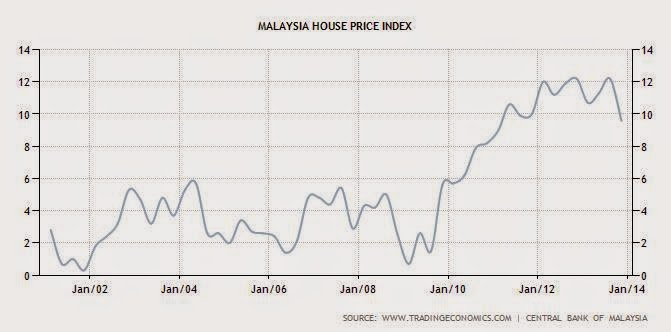
Indeed it has slowed down. Besides the house price index the number of property transactions has also fallen. If you don't believe in numbers just head to any property fair in town and you can count the # of visitors with your pair of hands.


The mighty flippers may flop

  • Situations like this are nothing new to Siva Shanker. He has seen loads of such cases and he does not see a rosy end to this tale. 
  • His 34 years of experience as a real estate agent tells him that Mr Lam will either start cutting down his expenses so he has spare money to service the banks loans until a buyer comes along. “Or he will start borrowing from relatives or, worst still, from loan sharks.”
  • A sharp rise in value (of properties) creates the flipping culture,” he tells The Establishment Post. “In 2010, 2011 and 2012, thousands of properties were sold to flippers. These are people who neither need the property nor can afford to buy it. They buy it purely on speculation,” adds Mr Shanker, the immediate past president of the Malaysian Institute of Estate Agents.


Getting the DIBS on Malaysia Property Flipping

  • One of the reasons for a huge rise in flippers is the Developer Interest-Bearing Scheme (Dibs) where a house buyer need not pay down payment upon signing of the sale and purchase agreement. 
  • The developer will also bear the other expenses like stamp duty, legal fees and also interest on finance during the project construction period until the handing over of the keys. In essence, the buyer only pays for 90 per cent of the property value. In Malaysia, down payment for properties is at 10 per cent.
  • But speculators do not realise is that the value of properties sold under Dibs are actually marked up. This artificially hikes the property value and has caused the property market to rise unnaturally. 
  • Dibs was scrapped in Malaysia Budget 2014. Bank Negara was forced to take this measure when household debt soared to 86.8 percent of gross domestic product in 2013.
  • But the worst is not over. The effect of Malaysia property flipping is going to hit the property market in a bad way, according to Mr Shanker. “We will see a new category in property transactions – properties from flippers.” Presently, all property transactions involve the primary market, which are the newly built units, and the secondary market, which are the houses built and bought long ago that have now been sold.
  • He feels this category of property transactions will constitute a sizeable “5 to 10 per cent of new stock”. Flippers may be forced to sell their properties at much reduced, or even lower than the purchase price, so not to be saddled with a property they cannot afford to hold. 
  • So when a sizeable number of properties are made available in the market at much reduced prices, it is not going to be pretty for property investors and owners.

My comments : 
Everybody knows Malaysia has the highest household debt to GDP ratio in Asia. Below was taken in 2013, it is even higher now. 
House prices are lagging indicators of the economy (& our economy is not doing good) simply because it is illiquid (you can't sell it as fast as selling off shares). I told a couple of folks that the year it's going to be is 2017 and I still stand by it.  

At present economic conditions, BNM will not raise interest rates. It cannot and will not. [1] Lower interest rate is needed to spur economic borrowing and spending during bad times like now. [2] An increase in the rate will burden borrowers, make credit harder to obtain and certainly will mean bad news for property as it based highly on leverage.

This is why the Ringgit will continue to weaken and there is nothing much BNM can do about it except to smooth the decline by burning more reserves.

Elsewhere, property flipping is losing its appeal

  • Property flipping is fast becoming a thing of the past in the West. “China, Singapore, Malaysia, Hong Kong are now where the West have been and gone through,” Vijay Manavalan, a property negotiator in Malaysia involved in promoting properties in UK for investment.
  • To get value out of property investment, it is best to get slow income, and not flip. There will not be many more markets around the world to flip. Investors need to look at the rental income that can be generated,” he tells The Establishment Post.
  • With a combination of government measures and diminishing opportunities, Malaysia property flipping may just be a thing of the past and Malaysian property market can be allowed to grow naturally and at a steady pace.

Thursday, June 18, 2015

Malaysian REITs in 2015 (Some Opportunities Exist)

Source: Dynaquest SPG, Kenanga Research, MIDF Research.

Potential Upside/Downside = Current Price/Net Asset Value
OP = OutPerform (more upside potential than downside risk)
UP = UnderPerform (more downside risk than upside potential)
MP = Market Perform (limited upside)
***My order of evaluation: Yield > Prospects > Discount/Premium Rate. Below are key highlights that I extracted from various sources as indicated above. And I generally ignore smaller REITs due to them being too illiquid & boring (ARREIT is an exception, covering it for a friend).

KLCCP Stapled Group (Diversified, Market Cap: RM12.583 billion)
Gotten shareholder's approval to raise funds of RM1.2b supposedly for potential asset acquisitions within KL's Golden Triangle (Suria KLCC only 60% owned, KLCC Convention Centre, Traders Hotel and Impiana Hotel. A key positive factor is PETRONAS being sole lessee of two key assets (Twin Tower & Menara 3 Petronas) under triple net lease arrangement for 15 years providing very good stability of income. OP because of acquisition prospects & triple net lease arrangement.
Kenanga Research RESULTS NOTE - KLCC STAPLED GROUP - 06 MAY 2015


Pavilion REIT (Malls, Market Cap: RM4.55 billion)
Da Men is expected to be completed in 3Q15 and Pavilion Extension done by mid FY16. The management still views the outlook for 2015 to be challenging amid weaker consumer sentiment due to GST and significant increase in the supply of new retail space in the Klang Valley hence MP rating (mall REIT usually commands a premium based on my 5 years data)
Kenanga Research RESULTS NOTE - KLCC STAPLED GROUP - 06 MAY 2015


IGB REIT (Malls, Market Cap: RM4.59 billion)
Owner of Mid Valley Megamall & The Gardens Mall. IGBREIT is unlikely to make any acquisitions in the near term despite their low gearing level of 0.32x. MP rating due to GST and retail space oversupply (mall REIT usually commands a premium based on my 5 years data)
Kenanga Research RESULTS NOTE - 29 APRIL 2015


Sunway REIT (Diversifed, Market Cap: RM4.81 billion)
Sunway Putra Mall (SPM)'s official reopening (refurbishment) with at least 50% occupancy -> 70% by Aug15. Sunway Putra Hotel (SPH) refurbishment almost completed while refurbishment for Sunway Putra Tower (SPT) is still ongoing and is expected to be fully completed by 4QCY15. Acquisition of Sunway Hotel Georgetown was completed on January 2015. MP rating due to GST (mall REIT usually commands a premium based on my 5 years data)
Kenanga Research COMPANY UPDATE - SUNWAY REIT - 16 JUNE 2015


CapitaMallsMalaysiaTrust (Malls, Market Cap: RM2.49 billion)
The acquisition of Tropicana City Mall (TCM) and Tropicana Office Tower (TCOT) is expected to complete by 3Q15. Earnings to be reflected in FY16. Strong income growth from East Coast Mall is expected to cushion the negative impact from the MRT work discruptions to Sungei Wang Plaza. Proposal for placement of new units to raise up to RM395.5m to fund its purchase of both TCM and TCOT (which have been priced at RM565.0m) is ongoing. MP rating due to GST (mall REIT usually commands a premium based on my 5 years data)
MIDF Research CMMT - DECENT 1Q15 RESULT


Axis REIT (Diversified, Market Cap: RM1.94 billion)
AXREIT has completed the acquisition of three assets, namely; (i) Axis Shah Alam DC3, (ii) Axis MRO Hub, and (iii) Axis Shah Alam DC2, and has already signed the SPA for the Industrial facility in Johor. However, the Prai asset is the only remaining asset yet to be acquired, and the due diligence is expected to be completed in 2Q15. Dividend payout increased in CY14 largely due to gains arising from disposal of Axis Plaza, this will not repeat in CY15. AXREIT also announced a 1:2 share split on 3rd March 2015, which is pending approval from SC, and to be followed by approval from unitholders. UP rating due to high premium rate leading to low yield. Way below the average REIT yield figure.
Kenanga Research RESULTS NOTE - AXIS REIT - 21 APRIL 2015


YTL Hospitality REIT (Tourism, Market Cap: RM1.35 billion)
Trust's property asset value of ~RM 3.0 billion comprising hospitality assets located in Malaysia, Japan and Australia and has more than 50% of investment in properties (by asset value) located abroad. Proposed increased in fund size from 1.324 billion units up to max of 2.125 billion units.
OP due to prospects of better earnings (weaker currency from all three countries good for tourism) and providing the best yield among all REITs.


AmanahRaya REIT (Diversified, Market Cap: RM510 million)
Earnings will be surpressed due to non-payment of rent by SilverBird Factory (11% of gross rental income) and shortfall of rental income from Wisma Amanah Raya Bhd after CIMB-IB tenancy ended in 2013. Acquired Wisma Comcorp for RM30 m in Dec 2014. Better to err on the side of caution until more information on earnings is clear. For CY15 it will be boosted by the disposal of Kontena National Distribution Centre 11 for RM34 million. Maintain MP due to uncertainty, however the good yield and discount more than offset the uncertainty.

Disclaimer: The reports, analysis and recommendations in this blog are solely my personal views. I do not link to any investment body or company. As such, I will not be responsible of any of your investment decision. Consult your investment adviser or come to your own conclusions before making any investment decision.

Tuesday, January 6, 2015

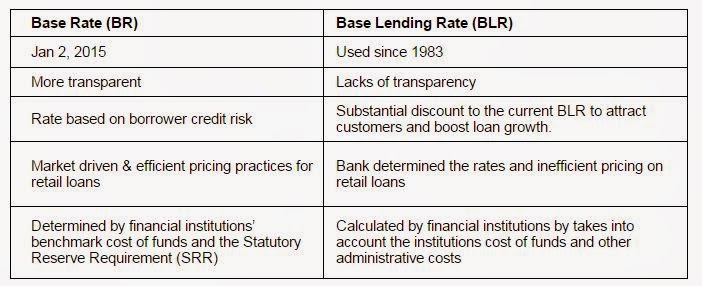
Base Rate vs BLR, Is This Just Another LPPL?

*Disclaimer: If the below information is inaccurate, lacking or omitted important information, please notify me. Thanks in advance.

As many of you know the new Base Rate (BR) mechanism is effective starting 2nd Jan 2015 which is to replace what we refer to as Base Lending Rate or BLR. New Reference Rate Framework by Bank Negara Malaysia (BNM). Both of these are set by the each bank individually, this is why the rates vary from bank to bank. However there they are very dependent on something called the Overnight Policy Rate (OPR) for the BLR and Statutory Reserve Requirement (SRR) for BR which BNM determines.

BNM meets every two months which fixed schedule in a meeting known as MPC (Monetary Policy Committee). This is where they debate and decide if the OPR and SRR should be adjusted higher or lower. The decision to do so takes in account various economic indicating factors (in no order), such as inflation, economic growth, strength of currency and etc. Basically the overall economic outlook. BNM adjusts the rate according to how much money they want in circulation versus how much should be tied up in savings.
MPC Meeting Schedule in BNM Website
The Effective Lending Rate (which you kena) is also determined by different factors which includes banks' cost of funds, their Statutory Reserve Requirement (SRR) account balances (how much they have in their reserve accounts with BNM proportionate to their eligible liabilities), borrower credit risk, liquidity risk premium, operating costs and profit margin.

The good thing is that the Base Rate must be reviewed by banks at least on a quarterly basis & the same to be disclosed publicly.
Base Rate and Effective Lending Rates of Banks 2nd Jan 2015
The Base Rate is also much transparent because banks are not allowed to lend below the base rate (except for cases specified by BNM).

For illustration purpose:
Loan Amount: RM350,000 (No Lock-In Period)
Loan Tenure: 30 years
 Before 2 Jan 2015
 From 2 Jan 2015
 Reference Rate BLR = 6.85% BR = 3.67%
 Interest Rate BLR - 2.20% BR + 1.00%
 Effective Lending Rate 4.65% 4.67%
 Monthly installment (RM) 1,804.73 1,808.93


You will immediately notice that the monthly installment difference is negligible. But of course the above is just an illustration. If you don't believe compare your Dec 2014 housing loan statement vs Jan 2015 housing loan statement. The reason why it differs slightly is because the BLR is dependent on OPR (3.50%) while Base Rate is dependent on SRR (4.00%). The spread is very narrow and therefore the effective lending rate is almost the same (plus minus here a bit la...maybe enough for a plate of Chicken Rice).

The Base Rate will be used for the new retail floating loans and refinancing of existing loans extended from 2nd Jan 2015. After the effective date, BLR based loans prior to 2015 will continue to be referenced against the BLR. Also, when any bank makes an adjustment to the Base Rate, a corresponding adjustment to the BLR will also be made. Currently, the BLR is 6.85% while the prevailing mortgage rates hover between 4.20% to 4.90%.
    
Why use SRR now?
It is a BNM tool for the purpose of liquidity management. Effectively, banking institutions namely commercial banks, merchant/investment banks and Islamic banks are required to maintain balances in their Statutory Reserve Accounts (SRA) equivalent to a certain proportion of their eligible liabilities (EL), this proportion being the SRR rate.

As explained above, higher SRR means that banks in Malaysia will have to keep more money as their reserve. This translates into lower loans growth for banks. Normally, banks would impose stricter loan approvals for borrowers, because less funds are available for lending. Normally, very high SRR translates into lower profit growth for banks, lackluster borrowing and lower economic growth (who doesn't like to leverage?)

Since SRR is available to BNM to manage liquidity and hence credit creation in the banking system, it will be used to withdraw or inject liquidity when the excess or lack of liquidity in the banking system is perceived to be large and long-term in nature. Currently, BNM believes that our banking system is OKAY in liquidity, thus it maintained the SRR since 2011 to "buffer" some money in banks.

"KUALA LUMPUR: Bank Negara Malaysia (BNM) Governor Tan Sri Dr Zeti Akhtar Aziz said the Statutory Reserve Requirement (SRR) will only be adjusted if there is a fundamental change in liquidity in the financial system.

"SRR will only change if there are fundamental shifts that result in fundamental changes in liquidity condition. If it is temporary, then it will rely on open market operations,""

Conclusion
It looks like it is LPPL. However this is because the spread between OPR and BLR is very narrow. It is not as straight forward as it seems. If BNM raises OPR and thus BLR but maintains SRR, consumers will mostly likely refinance. There is a lot of juggling going around.

With the fall in oil prices now at $50, down $5 in a single weekend coupled with further weakening of the MYR at 3.55 to USD, impeding 6% GST, things don't look well for us. It remains to be seen what BNM will do when it meets again on 28th Jan 2015. We as consumers will still need to pay attention to OPR and in addition the SRR now.

Saturday, November 8, 2014

Let's Talk About The Shining Metal..Again

Precious Metal: Gold
Rating: UNDERPERFORM (KEEP IN VIEW)

Current Price: $1,179 (from $1,334)

Target price: $1,100 to $1,150 (unchanged)

Fundamentals: Long Term Outperform (5-year period)
Sentiment: Medium Term Bearish (6-month period)
Risk Level: High

**Outperform: Expected to do better than market return; has upside or cheap vs target price. Usually a buy call.
**Market perform: Expected to be on neutral, can be + - 3% to 5% either way; Usually a hold call.
**Underperform: Expected to do worse than market return; has downside or too expensive to buy vs target price. If fundamentals change a sell call.


I have talked about gold a couple of times. 

First was back in late 2012 -> http://aboiwealthpot.blogspot.com/2012/10/the-yellow-fever.html. This was when gold was at it's all time high of $1800 and I have warned the perils of holding gold.

"To the disbelieve of ordinary folks, gold is just like any commodity. IT DOES NOT GO UP ALL THE TIME."
"If you have gold now, it's time to review your holdings. If you are thinking about getting into gold, think twice and HARD. A few useful indicators to look out for. 
No 1. If the central banks of major economies start raising interest rates, it is tough for all investment classes which includes gold. Because there is little point in putting cash into the banks when interest rates are low, people will buy gold as a hedge against inflation.
No 2. If the US dollar has strengthened, decrease in gold prices will follow. This is because people use gold as a substitute/hedge for the world's reserve currency."

No 2 is happening now. No 1 at the current trend would only apply to the US economy where it is foreseeable that the Fed will raise interest rate as early as 2015.


Next I posted in late 2013 -> http://aboiwealthpot.blogspot.com/2013/12/a-fool-and-his-gold-are-soon-parted.html. This was when gold of $1250 was experiencing a sharp decline.

" increasing demand does NOT come from jewelry or technology (I consider this a stable form of demand) it is from financial investments (speculative/hedging form of demand)."
"Equities or stocks are by far the best indicator to look at. It does not correlate with gold prices. E.g. if US stocks fly high, gold prices would be the opposite OR if interest rates goes up, folks would rather invest in cash rather than gold."

The US stock market is at it's all time high now, higher than pre-crisis levels of the 2008/2009 financial crisis.


Lastly I posted in early 2014 -> http://aboiwealthpot.blogspot.com/2014/03/speaking-of-recent-gold-demand-trends.html. When gold of $1350 made a small comeback.

"The only major factor keeping gold supported now is the RETAIL INVESTOR, people like me and you but actually not really us la. Whose buying them? The Chinese and Indians especially!"
"Back by India's restriction to limit gold import in mid 2014 and China's appalling just released PMI index, gold is going to meet resistance in the $13xx range."

It is did meet substantial resistance and is now hovering below $1200.

Let's examine what is happening now @ <$1200:
[1] I put the normal retail investor as either buying jewellery or investment such as physical bar demand. Both are running out of fuel. Though there is no Q3'14 data yet, judging by the current price it is safe to assume the trend is resuming.
[2] India's new PM Modi wants the Indian people to use banking instruments and hold less gold and is making it one of his to-do list and with the restriction to limit gold import (that will last to 2015) is hurting retail demand in India.
[3] China's demand is waning as well. Could it be President Xi Jinping's massive anti corruption drive (which will continue for years to come) hurting demand for luxury good such as gold? 

[4] Strong US dollar and with the US Fed finally ending its QE3 program, it signals that it is almost time that they will start raising interest rates which will further boost demand for the greenback that will hurt gold. This is because holding the shining metal has no yield (it does not pay any interest).

[5] Also BoJ's (Bank of Japan) just announced an aggressive QE program of it's own. This will boost the stock market of Japan, fueling the flow of money into equities. The ECB (European Central Bank) might be mulling the same idea considering that Europe (except UK) is re-entering recession. Money has to flow from somewhere and it will come from commodities like gold. Again because holding commodities has no yield.
[6] Russia might be selling some gold reserves to meet financial demands due to suppressing oil prices (which contribute a lot to the state budget) & also sanctions from Western countries.


How to get gold's fair value?
The answer is I don't know. It is not like an equity where various financial ratios can be used for in modelling e.g. PEGGY or DCF. What I do is simply identifying trends on the macroeconomics level - understanding what is happening around the globe e.g. be it financial or political. This is pretty much similar to how I did for palm oil where I was invested in BSDREIT and gained a nice 65% profit for holding it for 3 years. 

Back to gold, my target price ($1100 to $1150) and support line ($1000) remains unchanged. Pre-crisis financial crisis 2008/2009 prices were slightly below $1000 and at $800 as seen in 2007 when central banks were selling gold but now they are buying . Furthermore 100 tonnes each quarter for 14 consecutive quarters since 2011. In the long-term Jewelry demand should recover (with Asia's rapidly rising middle class), Technology demand to remain flattish, Total bar and coin demand as a form of investment will continue to slug as long as the markets around the world remains healthy. A majority of central banks should continue to hold and increase gold reserves as global monetary backup because the world economy remains unpredictable if not messier.

Thus I am assuming that demand will normalize to 2008 levels ~3800 tonnes per year. At the height of the gold price it was 4700 tonnes. Now it is trending to be similar to 2013. ~4000 tonnes per year.

In order to determine if gold is a good investment, one must have a view of the economic environment. Gold is a good investment when traditional assets are unlikely to maintain your purchasing power. That is, they are likely to depreciate when priced in gold, because they are tied to a declining economy. We are in one of these periods today and have been so for the last 12 years.

When growth is strong you will do better in traditional investments. They are exposed to growth and will outperform inflation hedges in such a climate. A classic example of such an environment would be the 1980-2000 period. Are we likely to enter such an environment again in the future? The key is to know when this new cycle has begun.

Warren does not believe in gold because it cannot produce anything, it has no output unlike holding companies and securities that offer yield. However I treat gold mainly as a CRISIS HEDGE and use the extremely long term horizon, holding for 10 years and above. With so much liquidity (money) in the system, there is plenty of fear in markets these days. Fear that paper assets will depreciate, fear that governments would not be able to repay their debts, fear that markets will collapse and etc. One thing I'm sure there will always be a NEXT CRISIS.


How to buy (approved by Bank Negara) gold in Malaysia?
You will need a current or savings account with the bank that is selling gold.
You will need to buy a initial minimum of 20g. At current price have at least RM 3000.
Subsequent buys must be done in bulks of 5g each. E.g. 5g, 10g, 15g and etc.
You should have a minimum of 10g in your gold account to avoid the monthly charges. If you intend to sell almost all just close the account.
UOB bank offers the cheapest gold price that you can purchase in Malaysia.
http://goldaboutinvestment.com/malaysia-banks-gold-price


On a side note:
Below is the US house price index. Post-WW2 house prices went up and stayed the same due to one sole thing: Population boom and rising middle class. The same goes to Malaysia back in 1980s to 1999 pre Asian Financial crisis. We have past that era. In fact our total % of working person to population will peak in 2020 according to the world bank. 

The America has had 3 housing boom & bust while Malaysia has had 1 before. My point here is everything that goes up above the trend will go down eventual. It applies to stock market, gold, house prices, even my Lego pieces. The difference is in the time frame due to the liquidity of the transaction. Why does it takes years for house prices to correct? Because it is illiquid. In the stock market I only need 3 days to cash out, can you do that for your home? As such you will need to look at a longer horizon. A decade (10 years) is a good measure. Go figure....


Anyway, we all know that my warning is WRONG and Malaysia continues to enjoy excellent growth in the property market. Have a nice weekend, please attend property expo(s), they seem to be the rage nowadays.

Wednesday, September 10, 2014

Malaysia REITs - Looking For My 2nd Durian Runtuh

What is a Real Estate Investment Trust?
REIT is a company that owns and operates income-producing real estate which covers commercial real estate sector. REIT can also lend money directly or indirectly to other companies to finance acquisition of real estate properties. REIT gives an average investor the opportunity to invest in commercial estate by purchasing a stake in a portfolio that they would not otherwise be able to purchase on their own. These companies are then able to finance their operations by raising money from your money through sales of common stocks.


You may look at my track record of BSDREIT (I highly suggest you read more of this to understand REITs) which has since went private. Here I begin my launchpad for a second time investing into a REIT. Why now? Yields have begun to look juicy and I desperately want to diversify more.


Take note of Market Capitalization (bigger is better), NAV/price (higher is better) & Premium/Discount Rate (-ve is better)

My Thoughts:
A bigger REIT has the advantage of providing ample liquidity during trading. Malls are especially big in Malaysia and diversified asset type coming in second.

Malls and retail REITs have low NAV/Price ratio (less than 1) leading to huge premium rates. As you can see the, 5 of the top 4 are all malls and you have to pay a premium due to the NAV-to-share price. They are too expensive and the valuations is hard to justify further without killing the already very low yield of ~5%-6%.

It is important to note that REITs are supposed to generate a higher returns (due to the higher risk factor) in terms of yield % than Fixed Deposits (3.5%) or Bonds (~4-5%). Because of this no big investor (fund managers) will pour more money into an already overvalued REIT that will lead to even lower yields.

As such I will put focus into drilling down into YTL, AmanahRaya and lastly AmFirst in that order. YTL is particularly interesting: it is averagely sized, has superb yield of 10% and is slightly on a discount now. Stay tuned!


Monday, December 30, 2013

MYR, The Gohmen, Interest Rates, Property - The Linkages

The ringgit like any other currency is subjected to swings due to capital flows in and out of the country's economy in line with the global supply of cash. While if you try to google you will get tonnes of bla la lala(s) on what makes a currency stronger or weaker relative to others. There is however one simple answer: it depends on the country's economy. The strength or weakness of a currency is what we 'orang tepi jalan' refer to as exchange rate. Weak currencies (undervalued) means per given local currency you can buy more goods locally than the imported ones. It is the reverse for strong currencies. A country usually tries to make their respective currency stable and this is done mainly via maintaining an economy that is productive enough with a responsible central bank that controls inflation. 

1. Being productive enough
-Tight fiscal discipline (balanced budget...not something we have in Malaysia for the last decade) and anti-inflationary monetary policies (also something our govt is clueless about). Before u "tembak-menembak", note the word productive enough, I did not say the country isn't growing. It is but it is the government spending using debt tremendously since 2008 on commercial enterprises to stimulate the economy and too often has been seen as funding large-scale projects that reward political crony capitalists and support their companies. Malaysia will be unable to move ahead into a higher income level while it remains held back by a lack of tertiary industry, an education system that is falling behind in technological expertise (our PISA results look like PIZZA) and a restrictive low-wage economic model. At least with Maths and Science in English, our kids had a fairly decent chance of moving to a higher income economy. That has just gone out the window. Malaysia's dependence on cheap uneducated foreign workers has depressed local wages and productivity growth. This is why moving forward in 2014 & 2015 the government has resorted to sharp subsidy cuts and new taxes in the form of GST as the only means to increase income.

A strong government with a well-established rule of law and a history of constructive economic policies are the type of things that attract investment and thus promote a strong currency. In the case of the U.S. dollar, its strength is further augmented by the fact that commodities are generally traded in dollars, and many countries use the dollar as a reserve currency which makes it strong even though their debt to GDP is 107% while Malaysia is 54.8%. "Someone said the govt leaders are now like "porn stars". They have no sense of value or shame anymore. They can go naked in public and they don't know they are doing something that is abnormal.". While many nations around the world have their own fiscal problems but none unlike Malaysia where we spend 75% of our budget on 'operating' expenditure and 25% on development needs and this trend shows no sign of abating.

2. Central bank that controls inflation 
-High interest rates help promote a strong currency, because foreign investors can get a higher return by investing in that country. A higher interest rate means a better return on bonds and other Government securities and will, therefore, tend to attract financial capital from overseas (this is called capital in flow). So, if Malaysia interest rates go up – or more importantly, are expected to go up – the Ringgit will tend to strengthen against other currencies, and vice versa. However this is a double edge sword for trading nations because a strong currency is bad for the country's export. Your goods are now more expensive and thus less competitive.


MYR performance against key currencies within Asia exc Japan

The Brunei dollar is managed together with the Singapore dollar at a 1:1 ratio by the Monetary Authority of Singapore (MAS). Singapore is one of Brunei's major trading partners. Without going to much details here's my outlook. Malaysian Ringgit will never catch up with the SGD, in fact it will widen even further as Singapore's moves up the chain from their current manufacturing -> hi-tech manufacturing (telecommunications/satellites/medical equipment). We would be trading sideways between HK/Taiwan/South Korea as these countries are also 1/3 export oriented & trade dependent (similar to Malaysia). I am unsure why we weaken against the Peso but my hunch is due to their outperforming stock market. Indonesia and Vietnam is not surprising as they are gearing up their manufacturing sector for exports and are poised to benefit more from a weaken currency.   

If you are looking to gain from currency the best bet is the Singapore Dollar. Need a vacation? Indonesia and Vietnam are good places for the coming years. And pray that we don't enter an economic malaise (our own lost decade: http://en.wikipedia.org/wiki/Lost_Decade_(Japan)) so we can still be comparable to our other closest economic competitors if not you need to carry your pack on your back.

In fact not all is smooth sailing for the outlook of the Ringgit.
1. We have been lagging behind (not productive enough). Who would invest in the country's stock market if not for the attractiveness & outlook of their economy? Sooner rather than later, we will be overtaken by Indonesia & Thailand in terms of market capitalization.

2005 Market Cap      2013 June Market Cap
Malaysia  184 bn       490 bn  (+166%)

Singapore  227 bn     752 bn  (+231%)
Indonesia 77.6 bn     477 bn  (+514%)
Taiwan  433 bn         754 bn  (+74%)
Shenzhen  125bn    1,190 bn  (+852%)
Philippines  32.4bn    230 bn  (+609%)
Korea  459 bn            3,051  (+564%)
Thailand  122 bn       408 bn  (+234%) 

2. If RM weakens further due to US tapering our central bank might need to raise interest rates later to keep it afloat but this is also difficult as it could potentially pop our debt bubble. But property bubbles do not get pricked so easily. When low interest rates is prevailing and other sectors of the economy are so weak, central banks cannot just raise rates to dampen property speculation as the broader economy will get hurt. This is the MAIN REASON why our budget is putting measures that are property sector specific. E.g. DIBS removal and the RPGT. We have been living on cheap credit for a very long time (causing loans to be growing at amazing rates) which is dangerous and interest rate adjustments were originally meant to be used as a short term financial tool. Our clueless PM... also the finance minister is punishing the devs instead by imposing the above when property seems to be the only growth industry in the country now. The overheating of the property sector is often caused by the Bankers - not the property devs. The Bankers make crazy property loans. It is better to increase the Bankers "prudency" in making property loans. HK and China did it and yes it will correct the house prices to an extent (30-50%) but it will NOT kill the property sector.

3. Our trade reliant country needs a balanced currency because a weaken ringgit also means Malaysian companies have to pay more to import large machines and construction equipment, or so called capital goods. With Malaysian carriers taking deliveries of airplanes and construction companies importing heavy cranes to build new skyscrapers like Warisan Merdeka, the country’s import bill is bloating, which will only swell with a falling ringgit. 

On a side note: Not that I actually believe it in this but have you heard of the http://en.wikipedia.org/wiki/Skyscraper_Index
"The Skyscraper Index is a concept put forward in January 1999[1] by Andrew Lawrence, research director at Dresdner Kleinwort Wasserstein,[2] which showed that the world's tallest buildings have risen on the eve of economic downturns.[3] Business cycles and skyscraper construction correlate[4] in such a way that investment in skyscrapers peaks when cyclical growth is exhausted and the economy is ready for recession."

As you can see walk left also wrong, right also wrong, up pun 'salah' down also 'tak betul'. Our narrow based economy has little room to maneuver and because we were one of the best performing currency (together with Thailand as well) when QE started back in 2009, our fall might actually be as bad as the rise. A lot depends on what the US fed will do whether they decide to taper even more. I think our time of cleansing would be happen when interest rates go higher. BNM would do whatever it takes to keep interest rates at current levels for as long as it could with our rm440.8 billion reserves as our only weapon left to fend of a falling Ringgit. No rocket science people...just need to stop playing Dota and catch up a little more on news (US Fed moves, BNM news, Budget announcements and most importantly what's coming out from the mouth of our clueless PM). 2014/2015 are going to be tough years for all of us.

Here is my conclusion: Time to be aware of what is happening

Saturday, March 19, 2011

Shitty Property Prices In Malaysia Part 1

A more appropriate title would be shitty property prices in Penang and Kuala Lumpur but anyway, there was a recent article by NST regarding affordable housing.

"In 2009, the average house price in Kuala Lumpur was RM390,000, almost six times the average household income. It was even worse on Penang island, where the average house price was RM540,000, or eight times the average household income."

Why is this in important ratio? The price-to-income ratio is perhaps the most commonly used ratio to judge whether a valuation is too high. The internationally accepted ratio is 3-4. Most of us know that the median monthly household income is RM4000 but as an urbanite say in Penang I will put it as RM6000 to RM8000. Therefore you can put a fair value on a middle-class home (2-storey terrace or a 1,500sq ft condo) at RM288,000 to RM384,000. The current prices of RM550k to RM700k pushes that ratio like as reported 8 times the average household income.

Let's look at another ratio known as debt-to-income ratio. A good rule of thumb is to use a ratio of 0.3 for housing loan. Taking back RM6000 and RM8000, a family could afford to pay RM2000 to RM 2667 in monthly installments. Just punch in this figure into the Home Loan Affordability Calculator with 5.5% interest and max loan years (30 years). Waalahh...you have an affordability range of RM350,000 to RM470,000. By combining the PI ratio and DI ratio you get a fair value of RM425,000 for a middle-class housing. Anything above that is speculative and bullshit.

Just take a look at how the US subprime crisis developed.
Like many other bubbles, one of the most important reason is easy credit and that is fueled by one factor called greed. Banks are now willing to lend up to 95% financing (oh gawd), they also offer variable rather than fixed-rate loans to reduce initial installments which is extremely good in a low interest-rate environment. Some even offer to stretch the loan tenure to 40 years! And recently heard offer for two-generation loan (70 years) and I am not lying look here, Japan did that last time and now still experiencing a recession for a decade dubbed the "lost decade".

When I speak to family & friends regarding housing price, the first thing in their mind are that house prices in Penang will always go up, at least 8/10 of them will mutter this. With some experience in the stock market, let me point this out. When everybody and I also mean the aunty in the market selling eggs says it is going to go up, it is a sign of bubble. You want to know why? The impression that money is easy to make. Take a real life example: SP Setia with their tagline your home is your "island of dreams", a reputable developer with no nonsense quality.
Say a property was bought at 700k and sold at 800k. Assumed you can secure a rock bottom loan of BLR - 2.3% during 2008. Household income at RM 8,000 (my max for an average urbanite in Penang). So the bank was offering 90% margin, downpayment was RM70,000 (pure cash). Now with 2.9% p.a. interest, served bank interest of RM 35,960 and forget about the exit penalty for early settlement. Profit at RM64,040, walao lee.

ROI: 64,040/70,000 = 91%
This is LEVERAGING at its best especially at low interest environment & superb financing margin.

If sold at RM 750,000, you can still profit RM 14,040 - BUT - ROI is 14,040/70,000 x 100 = 20%. Still not so bad laa, 20% is better than aboi's 15% p.a. stock returns.

What about when the property price jumps from original RM 700 k to RM 1 million in just months. The potential profit is even more drooling, RM 264,040 or ROI of 377% over a period of 1-2 years. Who don't want lee??? Why wait?? Join the fun la.

Can you see why people get greedy easily and why this there is great temptation to get into this boat? Just flip the prices for 3-4 times enough la and then exit. The truth is, it is hard to exit when your ego takes over and every single bit of rational evaluation goes away. Same thing happens all the time in every asset class, from stocks to commodities to even property. The trouble with property is that it is an illiquid asset class and it takes years to form a bubble (maybe 10 years or so) before bursting unlike the stock market.
Foreign people are buying. Come on la, these buyers are speculative, simply go to any high-end condo and see how many vacants are there. Like Dali said, if you can find 50% occupancy rate, call me and tell me where! Locals won't buy from foreigners so their best bet is to offload to another foreigner. But I heard that Malaysia are among the few countries in SEA that allows foreigners to buy landed property only if priced above RM500k which explains why more and more developers have this min price bracket if not higher for the new launches.

Malaysia still relatively cheap compared to rest of Asia. Property prices is kind of a reflection of the people's earning power in that country. If you compare like this you saying that my salary of say RM5000 will double or quadruple because it is lagging to Singapore which is so far ahead of us. Duh!

Penang is an island and therefore has limited land just like HK and Singapore. Have you ever examined the topography and population of these two islands and compare it to PG? HK you have 7mil and SG you have 5mil. PG is 1.5mil and yet we still have land. Land? Where? West side of the island and mainland. A big factor is population and it needs to be cramped. Look at PG, we have more landed houses vs skyscrapers unlike HK and SG. Learn to use google earth.

Certainly it takes times to see it burst or a correction but I can say for sure it is coming whether that will be a hard landing or a less painful one we will never know as it is not easy to make a prediction. House prices will hardly fall unless you see people start losing their jobs OR when you can see a young fresh graduate able to afford a RM500k property without any help from their parents, then you can shoot me back and say that prices are affordable and it will go up higher. Houses in PG are already 40% to 70% overvalued. It took the US 50% to burst. You tell me, is the end near?

Almost all other valuation matrix (besides the PI and DI ratio I showed you) in each category of house in PG will put them as overvalued and I will show you this in Part 2. Meanwhile this a a good article on Why Malaysian Real Estate Is So Cheap.

Thursday, September 16, 2010

What About Investing in Property?


Objectives
There only two ways to get income from property: Capital appreciation gain or passive income stream via rental. Which is better? The answer is at an individual's level. Personally I would prefer a steady cash flow from the latter because at the same time the property being rented will also have appreciation gain over the years. Not everyone makes $$ or invest correctly from venturing into property, the same goes to every investment option available.

Consider a person who buys an apartment from loaning RM250,000 for 30 years loan has to pay approximately RM800/month to the bank. He/she decides to rent it out at RM650/month only. Most people will think that this is investing since you have an apartment that is rented to people BUT you do not technically own the apartment until you have settled all outstanding amount in the loan. In addition you are sapping RM150/month just to top up the payment, this becomes a liability instead.

He/she could sell for capital gain but with RPGT it is only wise to do it after the 5th year onwards. A prudent way is to generate rental income with a positive cash flow which is the main deciding factor before you say buy. A positive cash flow means rental received exceeds mortgage payments. If he/she managed to rent our RM1000/month, there will be a surplus of RM200/month. Within a year it could accumulate into RM2400 and if used to offset loan, could save 3-4 years in the 30 years loan.

Benefits
Tremendous leverage capability, in simple words means making money from money you did not have but which is borrowed. If you made the right choice, rental would help pay off installments and capital gain from value appreciation in the long run. This is the single most advantageous benefit over investing in the stock market.

Because you can leverage OPM (other people's money) a.k.a bank, the banker would be glad to take your property as collateral. This is also something that cannot be achieved in the world of stock market. If you borrow money for stock trading and lose it, you will need to dig more money out to pay it off.

Certainty of growing urban population in cities. With more people being brought into this world, cities will continue to grow creating demand. This has commonality with consumer stocks which are my favourites as many of you know.

Other lesser benefits:
Property will always have value. Well the same goes to stock if you choose a right company. I agree that a property might lose value but zero value, the question is; Will someone buy it from you? Unlike shares you can sell it easier.

Hedge against inflation. As long as the returns are better than FD you can say it is a good hedge. Same goes to stocks, 15% compounded growth rate is more or less an ideal percentage in property as well. Though people will say they earn more than 20%-30% in the case of buy before launch and sell later, I really think people are jumping into greed without knowing the consequences. See what happened in the US housing market. This is exactly why our government imposed RPGT back again and why Bank Negara is mulling over 80:20 LVR and disallow 100% or 95:5 financing. Kudos to them!

Real Property Gain Tax (RPGT)
Announced during 2010 Budget, RPGT will only be applicable to properties that are sold within five years of their purchase. This is an attempt to curb speculation activities in Malaysia. RPGT will only take effect if you make a profit from disposing your properties within five years of purchase. The tax is on the profit made after deducting allowable expenses such as legal fees and stamp duty paid.
RPGT Tax Structure
But if the property loses value, tax relief is provided for the allowable loss if disposal price is equal or less than acquisition price. There are also exceptions from being taxed which includes:
  • Transfer of ownership from husband or wive & vice versa.
  • Transfer of ownership from individual to company if you hold shares in the company.
  • Transfer of property as collateral to loaner.
  • Inheritance of the property.
  • Disposal of assets as charity.
  • Acquition of property by government under any law.
Citizens and permanent residents also enjoy an exemption of RM5,000 or 10% of the gains whichever is the greater, besides a one-time tax exemption on the gains arising from the disposal of one private residence. This one-time tax exemption is most useful to us and can only be used for one residential property but with a catch. Husband and wife can only be exempted only once jointly. This means that upon ROM, the wife will automatically lose her individual right for exemption if she had not exercised it yet. So for those not yet married but considering to go into property for the 1st time please so do before you go off a anxiously signing your cert as you will lose one right!

Having explained RPGT, tax rates and exemptions might change from year to year especially during budget announcements so keep an ear to it. The next budget for 2011 will be tabled on 15th October 2010.

Is there a bubble brewing? 
Unlike stock market, it is difficult to comprehend whether there is a bubble in making for the real estate market. Thus we need to be on the lookout for signs or clues that gives us possible hints on the current market condition. One of them is from NAPIC (National Property Information Centre). There is a wealth of information in its website, do check the publications section.
Property Overhang Statistics by Quarter
The other clues are the government's reintroduction of RPGT and BNM proposed move to enforce a 80:20 loan-to-value ratio for house financing. From NAPIC, checks on developments completed this year also show that vacancy rates remain at 50 per cent or higher. Such high vacancy rates tells me possibly two things: foreigners buying our property and leaving it empty & Malaysian abroad who have higher purchasing power due to foreign currency. The second is quite possibly as we have as much as 350,000 working abroad and they might buy for retirement which explains the higher vacancy rates as well.

What I do know is that most of the units are taken up by employees of the developer hoping to sell for a profit when the development is completed. Act of greed and greed fuels speculation which in turn results in a bubble. With 2/3 of the Malaysian population surviving with less than RM4,000 a month with another 1/3 earning less than RM700 per month how long can the prices be sustainable in the long run? Asians in general have the habit of family helping other members even in their financials. Ask the current generation of young families and some will tell you their house is not entirely financed by them but helped by parents. Again how long can this go on?

A good chart to show whether bubble is forming would be to compare three things: country GDP growth, house property price appreciation and salary increment in a single index chart. As you can see China's property market is still in good shape with property appreciation in line with household income. I really like the Chinese govt's actions in taming speculative activities. Sadly I have not yet finish on getting US and Malaysia's chart. I will post them as soon as possible.
China property vs GDP vs household income
With that in mind, it would be most wise to keep in touch with the property news, perform meticulous research and not follow the herd or listen to rumours. Always buy within your means and don't buy first and regret later. We all know that the rich or to be rich do things differently than the not so rich people. The same goes to investing. In due time I will develop my own strategies just like how I trade in the stock market.

*I did once say that to borrow money to invest is bad but I would like to expand it further by saying that leveraging is ONLY good provided it has a positive cash flow instead of becoming a liability. Don't borrow if it saps your cash flow for other investments or your savings.