Top Post Views

3: Malaysia REITs - Looking For My 2nd Durian Runtuh
4: Is Insurance Really Necessary?
5: Everyone Must be A Millionaire

Head to the watch list on the above tab to see my what's on my radar and foreseeable future postings =)

Decided to make adjustments on the way I blog & share due to time constraints and other commitments. In the coming weeks you should see them. Short updates but more frequent & concise.

Monday, September 29, 2014

No Suprise - Petrol Likely GSTed

Why petrol is unlikely to escape the GST posted to The Star on 27th September 2014.
My thoughts in blue.

NOW that the Pengkalan Kubor by-election is over, the touchy issue of petrol being subjected to the goods and services tax (GST) will probably see some credible discussion.

At the heart of the matter is the growing call for petrol to be zero-rated under the GST so that there is no tax imposed on the commodity.

The logic is that if petrol were to be imposed a GST of 6%, it would trigger a chain of price increases for consumers and, ultimately, a higher inflation rate.

Government officials, except for a rare comment here and there, have shied away from talking about the GST being imposed on petrol, fearing that it would be politicised. So, when there is a heated discussion on petrol and the GST, the official answer is that a statement would be released on the matter in due course.

But closer scrutiny suggests that it is highly unlikely that the Government would classify petrol as an item that is zero-rated under the GST.
In many other countries where there is GST or VAT including our closest neighbours Singapore, Thailand and Indonesia, petrol is subject to GST. It is of no suprise here that it will highly likely be so in Malaysia.

Firstly, petrol is already an item that is highly subsidised. What is the point of imposing the GST on a subsidised product?

Secondly, there is already a sales tax of 58 sen per litre on petrol being sold at the pump. But the Government does not collect this amount because the total subsidy per litre far outweighs the sales tax.

The amount the Government subsidises per litre depends on the global price of crude oil. Based on previous reports, the subsidy was estimated at 70 sen per litre when crude oil was more than US$115 (RM374) per barrel.

Global crude oil prices have over the past two months been hovering at less than US$100 per barrel. This is despite the war in the Middle East and the confrontation between Russia and the United States and Europe.

Experts are predicting that the outlook for global oil prices will remain subdued for some time to come, unlike previously where any sign of conflict would cause oil prices to flare up.
Because Petronas is contributing 20% (as of 2012) to our national coffers coupled with weakening oil prices, all the more reason to reduce subsidies and subject petrol to GST to compensate for revenue loss from falling prices. Pandan MP Rafizi Ramli estimated that Putrajaya could collect a revenue of at least RM3 billion in GST from fuel and diesel a year, and this will form between 12% and 14% of the total GST collection.

Now the advancement in technology to produce shale gas has changed the dynamics of the oil and gas supply-demand situation.

The production of shale gas has changed the supply-demand situation in global crude oil prices, too.

On top of shale gas taking away some market share from the traditional crude oil, the global economy as a whole is showing signs of weakness. In this respect, the economies of China and Europe are weak.

Assuming the experts are right and the global oil price remains subdued, it should mean that the Government subsidy bill for petrol will keep reducing.

When crude oil is trading at a band of between US$75 and US$85 per barrel, the Government no longer has to bear any subsidy for petrol at the pumps.
This is quite possible as the shale oil revolution is underway and has yet to peak. And below is just the United States (world's largest reserves). There are many other countries with large reserves hoping on the same wagon.
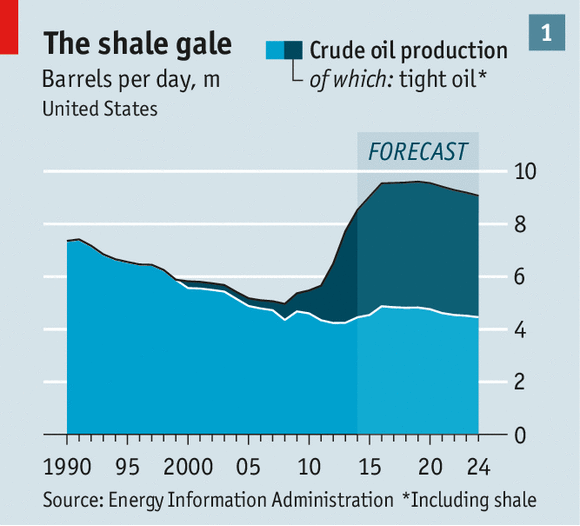
http://www.economist.com/news/united-states/21596553-benefits-shale-oil-are-bigger-many-americans-realise-policy-has-yet-catch
During the crisis in 2008, when crude oil prices fell below US$80 per barrel, the Government collected millions in revenue from the sales tax.

Considering the dynamics in the oil price situation, why would the Government classify petrol as a zero-rated item under the GST?

Petrol, after all, is a controlled price item. By making it a zero-rated item, the Government would lose its flexibility to impose a 6% tax should the global oil price fall below the US$75 to US$85 range, where there is no longer any subsidy and the 58-sen-per-litre sales tax mode kicks in.

As for consumers, because the GST is a consumption-based tax and the price of petrol is fixed, whether it is zero-rated or otherwise may not have much of an impact. The more the consumers use, the more they pay.
Here's the bad news. Consumers have not much of choice as public transport is poor. There is simply no alternative to the alternative. It would cost me RM8 for fares and 3.5 hours of travel per day if I would use public transport from home-work-home. Not acceptable.

For the rural and urban poor, the bigger problem is housing and employment.

For businesses, when there is a GST, the petrol expenses are part of their input tax that can be claimed back. So, technically, they should not complain. They wouldn't complain, they would simply pass the burden to consumers because every business owner will do so.

Lastly, if petrol is zero-rated, would the pump operators pass on any savings in expenses to the consumer? This is highly unlikely.

Also, if petrol is listed as a zero-rated item now, it would be a difficult task and politically explosive to take it out of the list should there no longer be any subsidy on the item.

The only comfort might be that the government would implement some form of new subsidy scheme that will be based on drivers salary and car engine capacity using an upgraded MyKad or a new fuel card to be distributed. Drivers with salary RM 5,000 while driving vehicle engine smaller than 2,000 cc will only be able to fully enjoy fuel subsidy. (these are only rumours)

Therefore, everything points to petrol being a GST item.

Monday, September 15, 2014

US Corp Share Buyback - Double Edged Sword

From The Economist Sept 13th - 19th 2014. My thoughts are in blue.
http://www.economist.com/news/leaders/21616950-companies-are-spending-record-amounts-buying-back-their-own-shares-investors-should-be

Companies are spending record amounts on buying back their own shares. Investors should be worried

FINANCIAL excess is more commonly associated with banks than with blue-chip companies. While the rich world’s finance industry—supposedly the brain of the economy—went berserk in the run-up to the 2007-08 crash, other big firms behaved sensibly, avoiding too much debt, keeping their costs under control and their eyes on long-term opportunities in emerging markets. But in the era of weak growth and low interest rates that has characterised the aftermath of that crash, there is growing evidence that the blue chips are engaged in their own kind of financial excess: a dangerous addiction to share buy-backs.

Over the past 12 months American firms have bought more than $500 billion of their own shares, close to a record amount. From Apple to Walmart, the most profitable and prominent companies have big buy-back schemes (see article). IBM spends twice as much on share repurchases as on research and development. Exxon has spent over $200 billion buying back its shares, enough to buy its arch-rival BP. The phenomenon is less extreme in other countries, but is becoming popular even in conservative corporate cultures. Led by firms such as Toyota and Mitsubishi, Japanese companies are buying back record amounts of their own shares.

Intel also does buyback in the tune of $20 billion announced back in July 2014 (before the spike in share price) and expects to repurchase about $4 billion in shares in the current quarter. This amount is similar to IBM. Intel spent $10 billion in 2013 for research and development. 

Buy-backs are not necessarily a bad idea. When firms buy their own stock in the open market they return surplus cash to their shareholders, in much the same way as if they were paying out dividends. And if firms can’t find opportunities for profitable investment, handing cash back to investors is the right thing to do. In many ways the surge in buy-backs is a symptom of the rich world’s feeble growth prospects.

But it could also be a source of trouble, for two main reasons. First, both short-term investors and managers have incentives that could lead them to overdo buy-backs and neglect long-term investment projects. The announcement of a buy-back scheme can prompt a sudden spike in share prices and a quick buck for the short-term investor. By reducing the number of shares outstanding, buy-back schemes can also artificially boost a firm’s earnings per share. This helps explain why managers whose pay depends on reaching specific earnings-per-share targets like to buy back shares. We will never know as it is only disclosed privately.

Second, some firms may be borrowing too much to pay for their buy-back habit. American companies, if one includes their global operations as a whole, are only moderately indebted; record buy-backs are being paid out of record profits. But the overall figures are skewed by a few cash-rich giants, such as Google. In 2013, 38% of firms paid more in buy-backs than their cashflows could support, an unsustainable position. Some American multinationals with apparently healthy global balance sheets are, in fact, dangerously lopsided. They are borrowing heavily at home to pay for buy-backs while keeping cash abroad to avoid America’s high corporate tax rate. Intel borrowed $6 billion for the sole purpose of buying back shares. Though the DE ratio is at a 'not to worry' ratio of 0.227 as of writing, the intent borrowing to do this for the first time is worrisome.
Intel's 5 Year Per Quarter DE ratio: It will continue to grow as long as profits do NOT compensate for growing debt

Let's examine IBM's case where profits are not lowering down the debt ratio.
IBM's 5 Year Per Quarter DE Ratio: Ever growing. 2014 saw massive borrowings for buy back scheme.
IBM's 5 Year Per Quarter Gross Profit: Not affected by crisis but also NOT growing 

The difference between a growing business and not.

Intel's 5 Year Per Quarter Gross Profit: Grew when demand needed to replenish inventory during global recovery but relatively flat since peak of 2011
Costco's 5 Year Per Quarter Gross Profit: Ever growing PER quarter
Drawing a line
If firms are overdoing buy-backs and starving themselves of investment, artificially propped-up share prices will eventually tumble. That is why investors need to pay close attention. In the long term they need to ensure that bosses’ pay schemes are designed in a way that does not create a perverse incentive to repurchase stock. In the short term, they must give willing firms a licence to invest. There are some signs that this is beginning to happen. According to a poll by Bank of America Merrill Lynch, a record majority of fund managers now think firms are investing too little; only a minority want higher cash returns. That is welcome: shareholder capitalism is about growth and creation, not just dividing the spoils.

Wednesday, September 10, 2014

Malaysia REITs - Looking For My 2nd Durian Runtuh

What is a Real Estate Investment Trust?
REIT is a company that owns and operates income-producing real estate which covers commercial real estate sector. REIT can also lend money directly or indirectly to other companies to finance acquisition of real estate properties. REIT gives an average investor the opportunity to invest in commercial estate by purchasing a stake in a portfolio that they would not otherwise be able to purchase on their own. These companies are then able to finance their operations by raising money from your money through sales of common stocks.


You may look at my track record of BSDREIT (I highly suggest you read more of this to understand REITs) which has since went private. Here I begin my launchpad for a second time investing into a REIT. Why now? Yields have begun to look juicy and I desperately want to diversify more.


Take note of Market Capitalization (bigger is better), NAV/price (higher is better) & Premium/Discount Rate (-ve is better)

My Thoughts:
A bigger REIT has the advantage of providing ample liquidity during trading. Malls are especially big in Malaysia and diversified asset type coming in second.

Malls and retail REITs have low NAV/Price ratio (less than 1) leading to huge premium rates. As you can see the, 5 of the top 4 are all malls and you have to pay a premium due to the NAV-to-share price. They are too expensive and the valuations is hard to justify further without killing the already very low yield of ~5%-6%.

It is important to note that REITs are supposed to generate a higher returns (due to the higher risk factor) in terms of yield % than Fixed Deposits (3.5%) or Bonds (~4-5%). Because of this no big investor (fund managers) will pour more money into an already overvalued REIT that will lead to even lower yields.

As such I will put focus into drilling down into YTL, AmanahRaya and lastly AmFirst in that order. YTL is particularly interesting: it is averagely sized, has superb yield of 10% and is slightly on a discount now. Stay tuned!